Option 1: Answer it yourself, faster
Cost: $0. Effort: Constant.
The default. Answer when you can, return missed calls when you can't. Some owners do this well — they answer most calls, return the rest within 15 minutes, and the system holds together.
When this works: Single-trade owner-operator with under 80 calls/month. You're disciplined, your customers are forgiving, you don't have a spouse complaining about phone time.
When this breaks: When you scale past one truck. When you take a vacation. When you hit a heat wave or storm surge. When the missed-call list grows faster than you can return it.
Option 2: Voicemail-to-text + 5-minute callback rule
Cost: $0–$10/month for transcription. Effort: High discipline.
Set up your voicemail to transcribe and forward to text. Make a personal rule: if I see a transcribed voicemail, I call back within 5 minutes, even from the truck.
When this works: When customers actually leave voicemails. As of 2026, most don't — voicemail completion rates are under 18% for residential service trades. So this catches less than a fifth of misses, and only the most determined customers.
When this breaks: Most of the time. The customer who didn't leave a voicemail is the customer you lost. This option only addresses the 18%.
The calls that ring out aren't ringing out because you're lazy. They're ringing out because you're working.
Option 3: Hire a part-time receptionist or have a spouse pick up
Cost: $1,500–$3,000/month for a part-time hire. $0 for a spouse. Effort: Moderate.
A real human picks up your phone when you can't. They take a message, qualify the work, and dispatch you back to the customer.
When this works: Established shops with stable volume and a person who genuinely wants the job (or a spouse who genuinely wants to do it). Family operations have run on this model for 50 years.
When this breaks: When the person isn't available — vacation, sick, evening, weekend. When call volume doubles in a heat wave and one person can't keep up. When the receptionist doesn't know the trade well enough to qualify a call (e.g., asks 'what's wrong?' to a homeowner who already explained it three times that week).
Note for spouses: Real talk — most shops we've talked to where the spouse picks up the phone end that arrangement within 18 months. It's a strain on the relationship and a brittle fallback for the business. Use with eyes open.
Option 4: Per-call or per-minute human answering service
Cost: $300–$2,000+/month depending on volume. Effort: Low after setup.
Smith.ai, Ruby Receptionists, AnswerConnect, AnswerForce. You forward your line, real humans answer when you can't, they qualify the call and message you the result.
When this works: Shops with consistent volume and an appetite for predictable service quality. The major players have years of operating history and the receptionists are trained.
When this breaks: Cost predictability during surges (per-minute services bill more during a heat wave precisely when you can least afford it). Trade-specific qualification — generic receptionists don't necessarily know what a 50-gallon gas water heater is or whether 'half my house is out' is a tripped breaker. Spam billing — most per-minute services bill spam calls unless filtering is enabled.
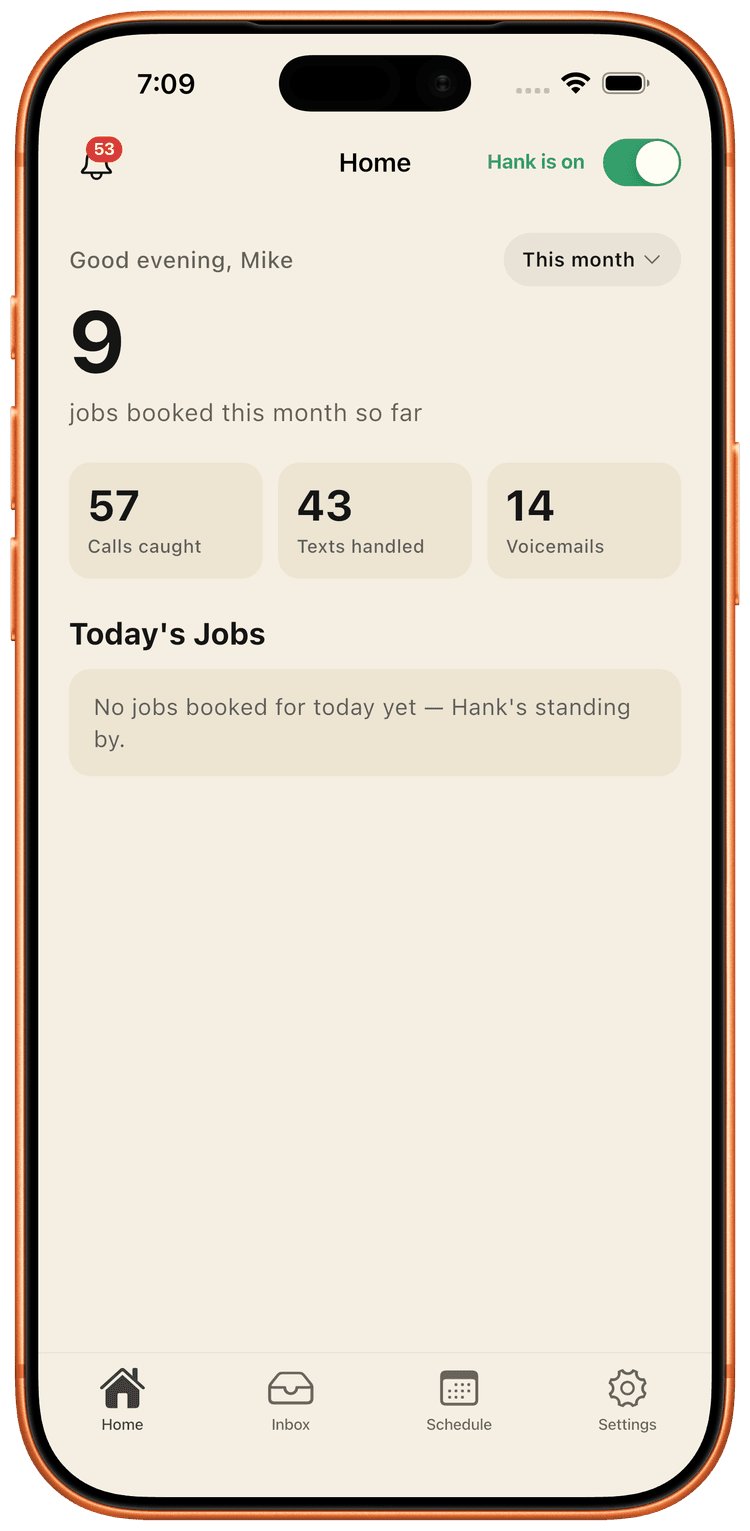
Option 5: AI answering service built for trades
Cost: Flat $150–$300/month at the lower end of 2026 pricing. Effort: Low after setup.
Newer category. AI picks up your phone when you can't, qualifies the work using trade-specific knowledge (it knows what condenser fan, P-trap, and tripped breaker mean), books the appointment, and texts you a clean job card. Flat monthly pricing means surge weeks cost the same as slow weeks.
When this works: Surge-prone trades (HVAC, roofing, plumbing emergency work) where per-minute billing punishes you exactly when volume spikes. Cost-sensitive shops where flat-rate beats variable per-call billing. Shops that value trade-specific qualification — the AI captures the right information from the customer the first time.
When this breaks: Genuinely unusual emotional calls (grief, anger, complex multi-step intake) — humans still handle these better in 2026. Shops in regulated-industry settings where every call has to be logged and reviewed by a licensed person. Shops where Spanish-language coverage is required today (some AI options haven't shipped that yet).
Decision shortcut
If your call volume is under 100/month and you can answer 90%+ yourself, stay on Option 1 with Option 2 as backup.
If you're at 100–500 calls/month and surge-prone (HVAC, roofing, plumbing), Option 5 is usually the math winner.
If you're over 500 calls/month with stable volume and you don't mind paying more for human nuance, Option 4 makes sense.
If you have a spouse who genuinely wants the job and you're under 200 calls/month, Option 3 (with a real conversation about boundaries) is fine for a few years.
Whatever you pick, the worst option is to keep doing nothing — for most shops, even the most expensive option pays for itself in the first month.
Stop missing the calls.
Free for 30 days, then $149/mo. Set up yourself in about 5 minutes — we’ll walk you through it if you want.
Get hank on your line